Visionary Wild, LLC • 2200 19th St. NW, Ste 806, Washington, DC 20009

E-mail: info@visionarywild.com    •    Tel: 1-202-558-9596 (9am to 6pm, EST).    •    Justin Black’s iPhone: 1-202-302-9030

We look forward to hearing from you!


0 of 10 spaces left | $6,250* Waitlist
Expedition September 14 - 25, 2013 | View other workshops

Grand Canyon by Raft with Jack Dykinga and Justin Black

What happens when a group of enthusiastic photographers join together for a 10-day raft trip through 226-miles of mind-bending Grand Canyon scenery and 1.84 billion years of geological history?

Here are some impressions that our friends from our last two trips have shared:

It's difficult not to heap superlative praise on Jack Dykinga and Justin Black for their photographic expertise and their absolute willingness to share that expertise with the rest of us.  They are truly visionaries in the landscape photography world, and their love of the Grand Canyon is infectious, and are a lot of fun to be around.

Having traveled to 5 continents, I can honestly state the Grand Canyon river trip was the best photo trip I have ever taken.

Seeing the Grand Canyon from the bottom is a visual and spiritual experience that is not to be missed by any photographer. This was my second trip down the Colorado River with Justin and I expect that it won't be my last.

My mind is still in the Canyon. Thanks to you, Jack and Justin, for putting together this amazing experience. The Canyon is past wonder. I am sitting here working on the images and can’t seem to leave the river.

While I think I've finally gotten the sand out of all of my clothes, equipment and person, it will most definitely be a long time before I get the Grand Canyon sand out of my soul. I think Jack said it best when he said that the Grand Canyon was a special temple. It is awe-inspiring. I really enjoyed my time with you all, and hope to see all of you again on another Jack and Justin adventure.

About two days into the trip...I realized that I should enjoy the trip because it was just about as good as it gets. It was indeed. At this point, maybe it's enough to say that I actually miss the sand and I hope we all will continue to keep in touch.

Designed by Jack Dykinga and Justin Black, this trip absolutely maximizes photographic potential and overall quality of experience that can be had during ten days on the Colorado River in the mile-deep Grand Canyon.

* Note: Please click the "read more" tab below right for all the details, the image gallery, and National Park Service compliance information.

Grand Canyon by Raft
Map via Google

Applying our experience of numerous Grand Canyon raft trips, and in collaboration with our hand-picked boat crew from Arizona Raft Adventures/Grand Canyon Discovery, we've developed an itinerary that takes advantage of favorable late summer conditions and sets us up for the best landings for photo excursions and camps along the river. Detailed planning and the expert skill of experienced boat crews we've worked with before are critical, because there's no going back upstream on the Colorado River.

Our itinerary starts in Flagstaff, Arizona, at the Radisson Woodlands hotel. The day before our departure for the river, we will convene to get to know each other (and catch up with returning friends), and Jack will make presentations to get your creative juices flowing and prepare you for photography in the Canyon. This will be followed by an orientation by AZRA staff to go over the game plan, safety, answer questions, and distribute dry bags for packing your personal gear. We'll set off early the following morning for Lee's Ferry, where our raft and crew will be waiting for us at our launch point.

A little about the raft: We will use a 32-foot-long raft built around a strong aluminum frame with a below-deck cargo hold for important items that tolerate getting wet, like camp chairs and cans of beer. Personal gear and camera bags will be stored in drybags strapped to lockers on deck above the waterline. Two expert AZRA guides will crew our raft, which is equipped with a quiet, 30HP, four-stroke Honda motor for steering purposes. The motor is shut off as we drift with the current down the river in stretches of calm water. We will be running a great deal of whitewater, and where you sit in the raft will determine whether you get soaked or stay dry (or dryish). Getting soaked by a big splash is a great way to cool off, as is floating a rapid in your life vest, which the guides offer as an option on occasion and as safety conditions permit.

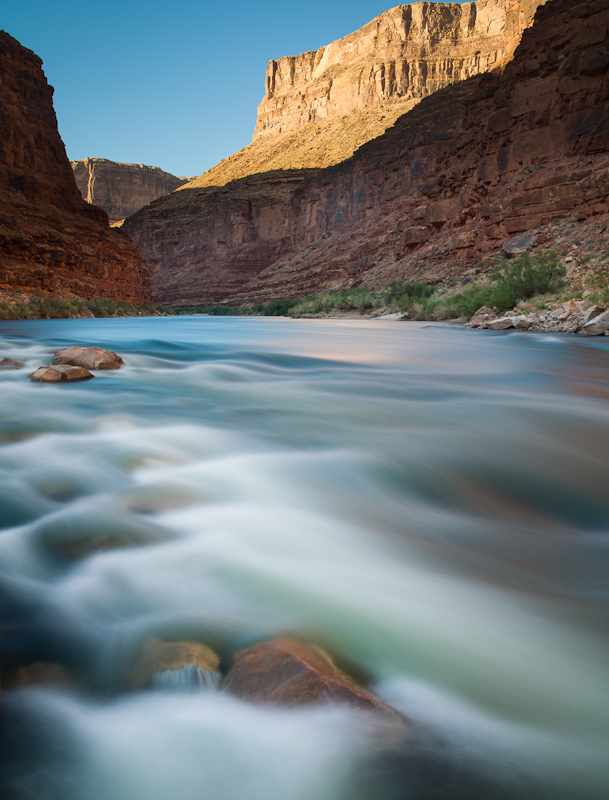
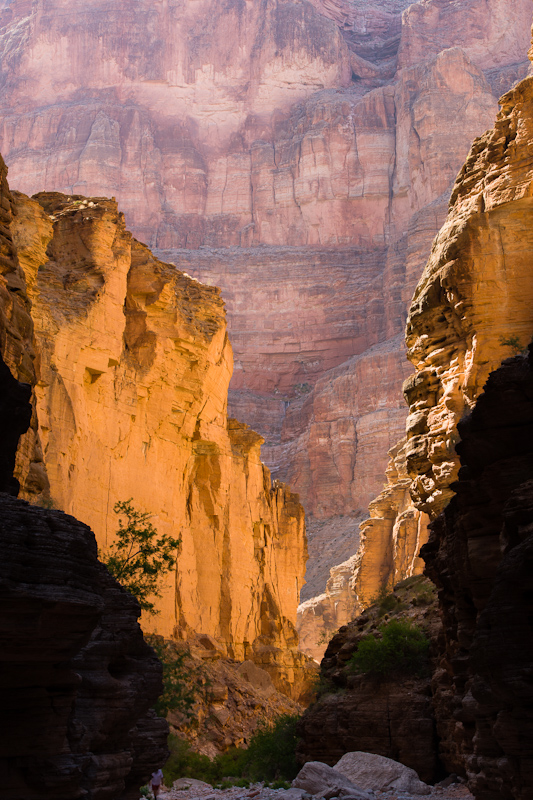
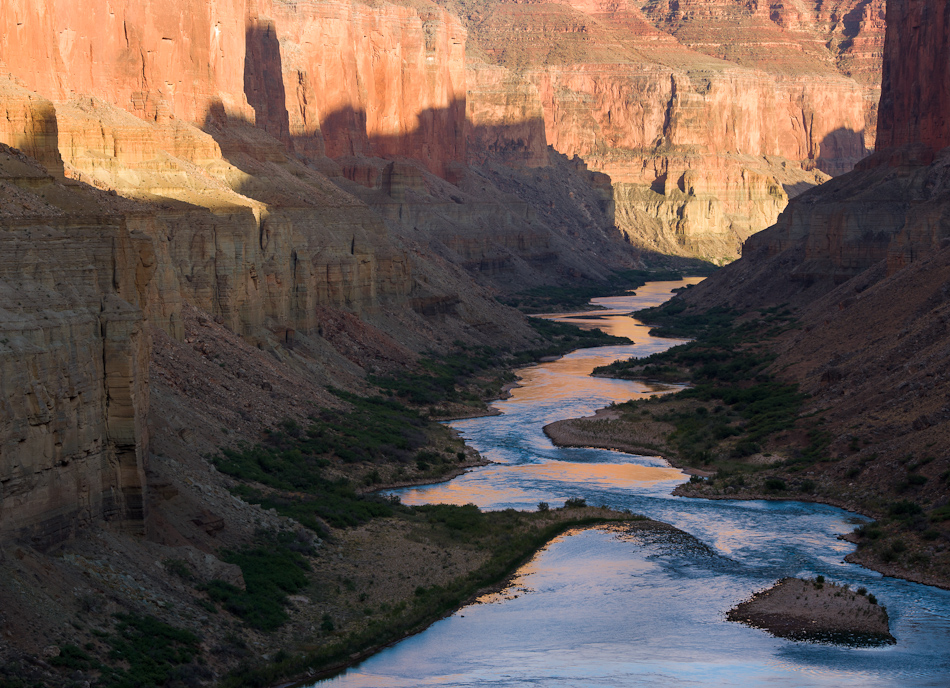
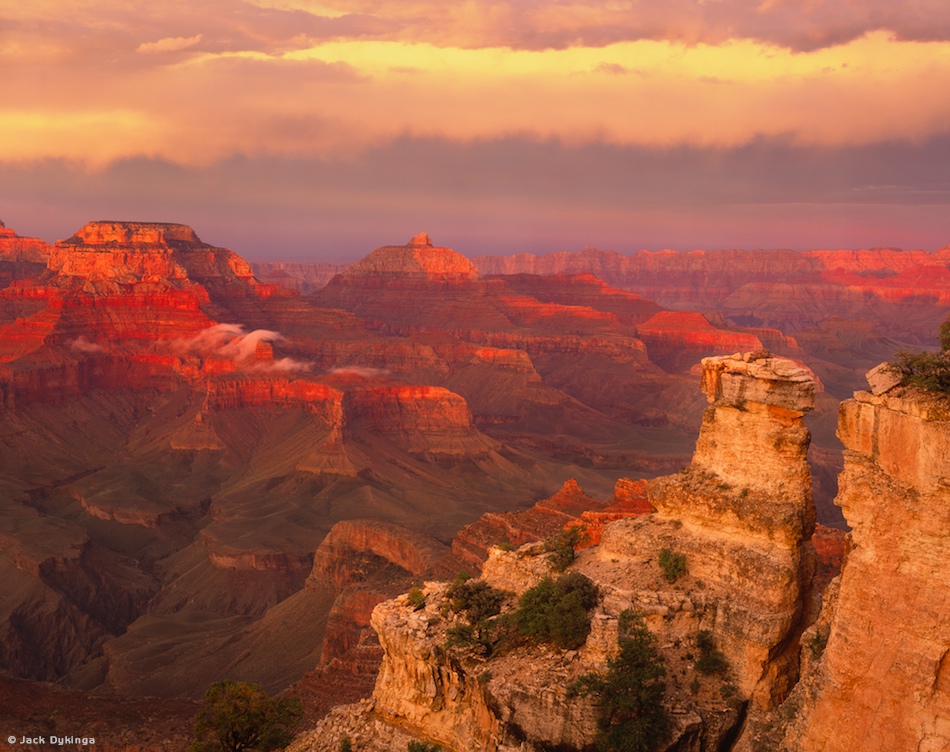
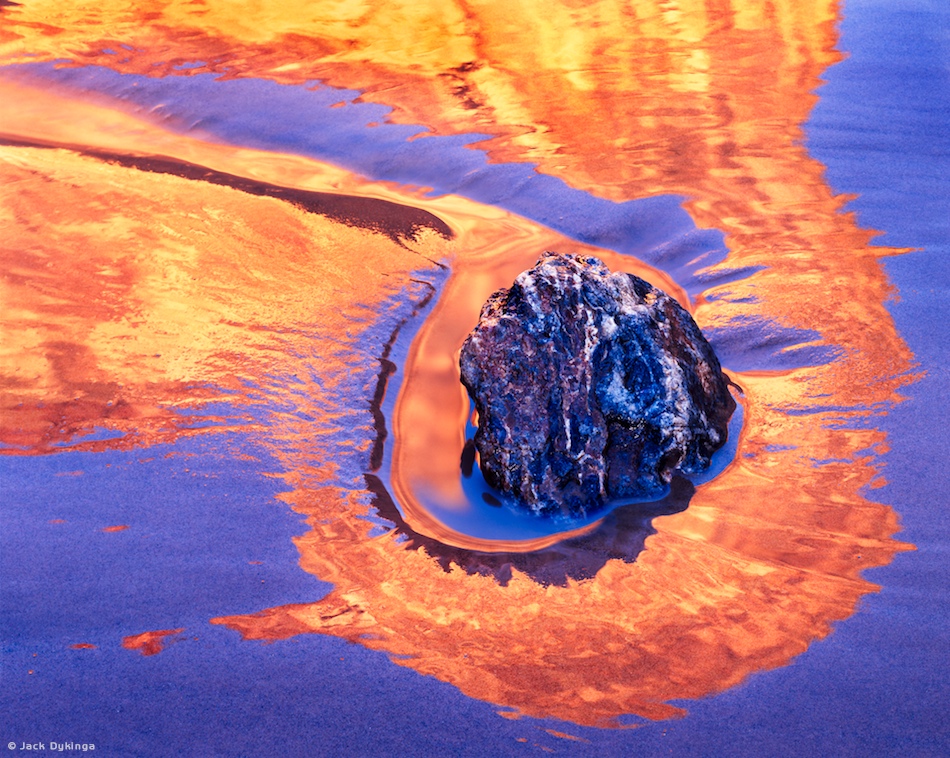
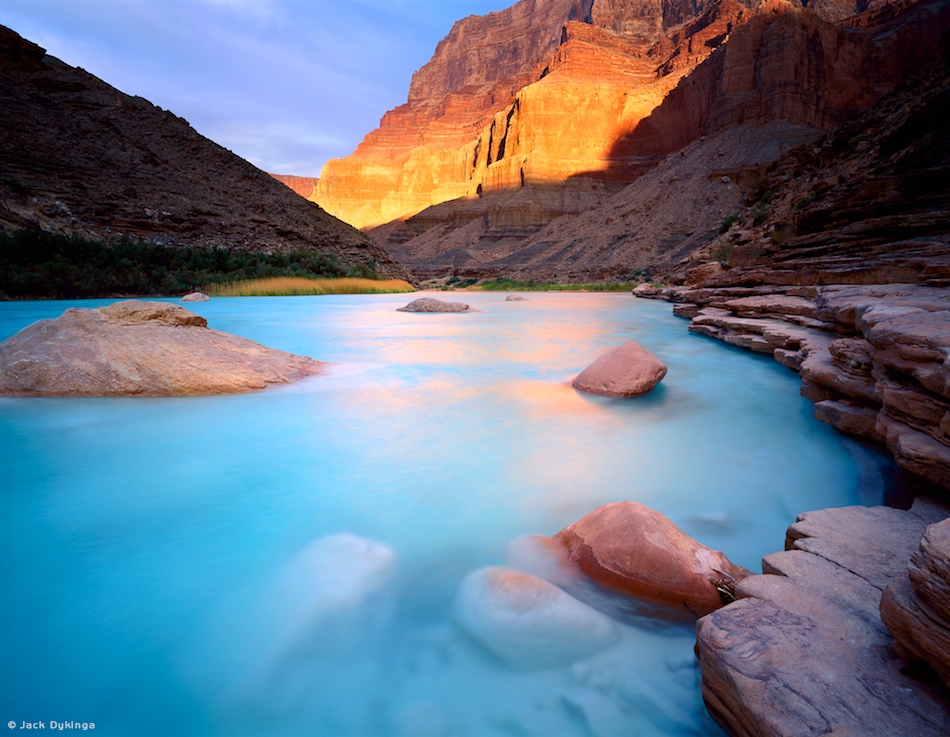
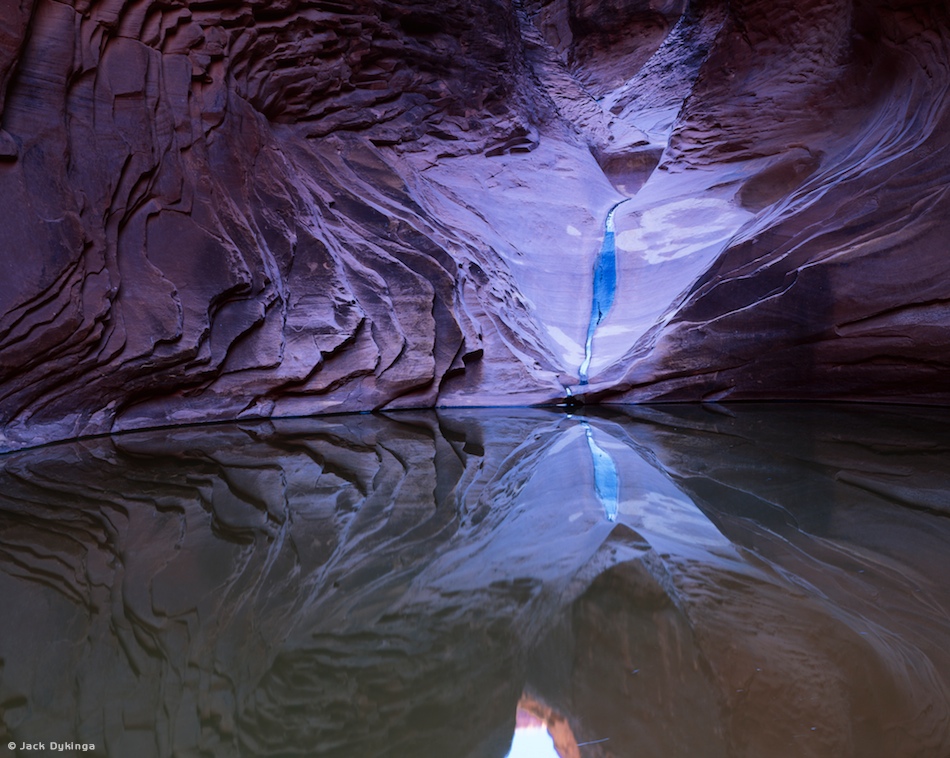
Once on the Colorado River, we quickly enter Marble Canyon and from there the canyon rim towers higher and higher as we pass through ever more ancient rock strata. From the raft, we'll take in the stunning mesas and rock formations all around us, watch bighorn sheep just a few meters away at the water's edge, marvel at condors soaring overhead, and watch the light and shade play across the water and reflect in hues of gold and red on the canyon walls. Each afternoon, we'll pull into riverside beaches, which will serve as our camps. These are selected in advance for group comfort and excellent photo opportunities close to camp in the evening, and to position us strategically to target the next morning's photography location.

As we arrive in camp each afternoon, we'll form a "bag line" as a team to unload personal gear and camp equipment from the raft to the beach. This group bonding experience is not to be underestimated. After that, we each locate our personal piece of Colorado River beach to put down our tarp, sleeping pad, pillow, sheet, and sleeping bag (all provided, as are tents, though no one seems to bother with them after a night or two). Then, while the boat crew prepares a fabulous and well-deserved dinner, we'll photograph in the evening light. Otherwise, choices of camp activities are up to you. We'll gather the camp chairs in a circle to chat over a beer or glass of wine, have a rinse in the river, or just relax and enjoy the peace, solitude, and crystal clear night skies.

When our time on the river comes to an end, it will be too soon. We will have been away from computers, smart phones, and traffic for ten days. AZRA will pick us up at Diamond Creek for the trip back to the Radisson in Flagstaff, stopping off on old Route 66 at Delgadillos Snow Cap in Seligman for an obligatory milkshake. After a proper shower and calls to loved ones to confirm that we've reemerged into civilization, we'll meet for a final celebratory dinner  with our boat crew at one of Flagstaff's finer restaurants. After breakfast the next morning, we'll meet to edit and project images for review and critique. Wrapping up by mid-afternoon, we'll say "until we meet again," and our merry band will part company with hard drives full of amazing images, heads full of incredible memories, spirits uplifted by the experience, and hearts just a little heavy that it's all over.

We hope you'll join us for this trip of a lifetime!

* NOTE: The raft-trip component of this package is operated through Arizona Raft Adventures/Grand Canyon Discovery, a licensed National Park concessionaire. In compliance with National Park Service regulations, we distinguish the cost of the AZRA ten-day raft trip itself, which is $2910 per participant. The fee for the photographic workshop prior to and following the AZRA raft trip, strategic photographic planning, and photo editing, design, and management of the group photo website to be created following the trip is $3,340. The portion of the package outside the raft trip itself comprises several weeks of pre-trip research and planning to include development of a recommended photo equipment list and photo packing guidelines, development of strategically designed photographic guidelines, technical, aesthetic, and conceptual recommendations for photography in Grand Canyon, post-trip critiques of participant photographs (both during the workshop portion and online after the conclusion of the itinerary), photo editing and website sharing of participant images in the weeks following the raft trip, meals in the days prior to and after the raft trip, lodging in Flagstaff the night before and the night after the raft trip, as well as all taxes and gratuities. The total combined cost for the raft trip and workshop is $6,250 per person, based on single occupancy at the Radisson Woodlands in Flagstaff.


Jack Dykinga

Taste life and strive to make a difference.

Pulitzer-Prize-winning photographer Jack Dykinga blends fine art photography with documentary photojournalism. He is a regular contributor to Arizona Highways and National Geographic magazines. His nine wilderness advocacy, large format books include Frog Mountain Blues, The Secret Forest, The Sierra Pinacate, The Sonoran Desert, Stone Canyons of the Colorado Plateau, and Desert: The Mojave and Death Valley. He authored and photographed Large Format Nature Photography, a “how to” guide to color landscape photography. Jack Dykinga’s Arizona, a compilation of Jack’s best Arizona images that was released in 2004 by Westcliffe Publishers, and Images: Jack Dykinga’s Grand Canyon, released by Arizona Highways in May 2008, reflect Jack’s love for the place he calls home.

Jack’s fine art images were featured along with the work of Ansel Adams in an Arizona Highways retrospective shown at the Phoenix Art Museum, the Center for Creative Photography, and the Museum of Northern Arizona.

His illustration of the wilderness lands of Native American tribes was featured in the August 2010 National Geographic magazine, and his coverage along the Texas/Mexico border highlighting the biological diversity of protected areas along the Rio Grande River appeared in the February 2007 issue of National Geographic.

Jack has donated his talents to the International League of Conservation Photographers' RAVEs (Rapid Assessment Visual Expeditions): El Triunfo, Mexico, 2007; Balandra, Baja Sur, Mexico, 2007; Yucatan, Yucatan, Mexico, 2009; Borderlands, US/Mexico, 2009; as well as the 2010 Patagonia, Chile, RAVE and the September 2010 Great Bear RAVE in British Columbia, Canada. In each case, Jack and teams of celebrated photographers from around the world pooled their collective talents to highlight potential environmental degradation.

In April 2010, Jack’s image Stone Canyon was selected as one of the Forty Best Nature Photographs of All Time by the ILCP, and he received the Outstanding Photographer of the Year Award from the North American Nature Photographers Association (NANPA) in March 2011.

Jack and his wife, Margaret, live in Tucson, Arizona.  His daughter, Camille Bralts, lives in Champaign-Urbana. His son, Peter Dykinga, lives in Tucson and manages Jack’s image collection.

Arizona PBS Interview with Jack:

An Interview with pre-digital Jack:

The Nature Conservancy's Director of Photography interviews Jack

National Geographic gallery of Jack's Native Lands project

Video: Profile of Jack Dykinga

Video: Interview with Jack Dykinga

Learning to See: an interview with Jack Dykinga

Visit Jack's website


Justin Black

One of my great joys is to witness a workshop participant's "Eureka!" moment – when the veil of obscurity gives way to clear vision and inspiration.

Justin Black is a professional landscape and nature photographer, and an affiliate member of the International League of Conservation Photographers (ILCP). Through both Visionary Wild and Galen Rowell's Mountain Light Photography (1999 – 2009) he has created inspiring and effective educational photographic experiences for over a thousand passionate photographers. He is widely recognized as one of the world's leading photo workshops organizers.

A professional photographer since 1995, before founding Visionary Wild he served the International League of Conservation Photographers (ILCP) as Executive Director, and for seven years was General Manager and Curator of Galen Rowell's Mountain Light Photography.
Justin's photographs have been published by magazines such as National Geographic Adventure, Sierra, Sunset, American Photo, Outdoor Photographer, Rock & Ice, and Nature Conservancy.

The Sierra Club, National Parks Conservation Association, Land Trust Alliance, Earth Justice, The Wilderness Society, Conservation International, the Chesapeake Bay Foundation, and the Wild Foundation are among conservation NGOs that have used his photographs in their campaigns, publications, and annual reports.

Justin has also served as an editor and contributor to numerous award-winning photo book projects, including Galen Rowell: A Retrospective; Freshwater: The Essence of Life; The Wealth of Nature: Ecosystem Services, Biodiversity, and Human Well-Being; Our National Parks: America's Natural Heritage; as well as Flying South: A Pilot's Inner Journey by Barbara Rowell. He is represented by the G2 Gallery in Venice, California, and Mountain Light Photography in Bishop, California.

An early career as a travel photographer and image licensing specialist led him to Mountain Light, the company founded by world-renowned National Geographic photographer, author, and mountaineer Galen Rowell and his wife, Barbara, in the San Francisco Bay Area. Beginning in 1999, Justin managed marketing of the Rowell image collection, assisted Galen on assignments and in his workshop program, and taught seminars on nature photography. In April 2002, Galen and Barbara invited Justin to relocate with them as Mountain Light's General Manager at the present location in California's scenic Owens Valley. Justin agreed and eagerly embraced the sublime Eastern Sierra Nevada landscape as his new home.

Four months later, Galen and Barbara perished in the crash of a chartered plane, leaving behind a tremendous creative and visionary vacuum. Justin went to work, building on the impressive Rowell legacy to reinvigorate Mountain Light by establishing a seasonal series of guest photographer exhibitions, expanding the image collection, and relaunching the highly acclaimed photo workshop program through collaboration with Galen's leading professional peers, including Frans Lanting, Pat O'Hara, Jack Dykinga, John Shaw, and David Muench. In May 2008, Justin's successful efforts were recognized by both Sunset and American Photo magazines, as each magazine featured editorial recommendations of his workshop program at Mountain Light. As of February 2013, the Mountain Light website continues to display positive client testimonials contributed exclusively under Justin's watch.

After ten years at Mountain Light, Justin was recruited for the position of Executive Director of ILCP, a non-profit association of the best photographers worldwide working in the field of nature conservation. At ILCP, Justin oversaw an explosion of productivity in expeditions, publishing, multimedia production, and the achievement of successful conservation outcomes. He contributed photographic coverage to ILCP conservation photography initiatives called RAVEs – Rapid Assessment Visual Expeditions – including Flathead (Canada, 2009), Yucatán (Mexico, 2009), and Chesapeake (USA, 2010), as well as a solo project documenting the Dragon Run watershed on Virginia's Middle Peninsula for The Nature Conservancy. One of Justin's photographs of the Flathead River appeared as a section opener in the Vancouver Sun newspaper – the first time the Flathead watershed conservation issue had any prominent coverage in that regionally critical media outlet.  The photograph was later selected by the U.S. Senate for display in the Capitol Building.

Justin left his position at ILCP in late 2010 to establish Visionary Wild, building on his successful leadership of the Mountain Light workshop program and applying expertise gained at ILCP to provide superlative workshops and expeditions for passionate photographers seeking to advance to the next level of creativity, quality, purpose, and meaning in their work. His own work continues to evolve in new directions, driven by the ongoing search for extraordinary qualities in our world's dynamic landscapes.

Justin lives in Washington, DC, with his brilliant wife, Lena (Visionary Wild's Director of Operations), and their son Philippe.

Justin Black's limited editions portfolio

Justin's Outdoor Photographer Profile

Bringing focus and meaning to your photography

The Top 40 Nature Photos Project

Justin’s Camera Bag

After using an array of 35mm, medium format, and 4x5 film cameras for most of his career, Justin has switched fully to Nikon digital SLRs and Nikkor lenses. His current gear includes:

Camera Bodies (Nikon)
D800E
D7100

Lenses (all Nikkor)
18-35mm f/3.5-4.5 G AF-S ED
24-70mm f/2.8 G AF-S ED
70-200mm f/4.0 G AF-S ED VR
24mm f/3.5 PC-E tilt-shift
35mm f/2.8 PC shift
45mm f/2.8 PC-E tilt-shift
85mm f/2.8 PC-E tilt-shift
85mm f/1.8 AF-D
105mm f/1.8 AI-S
200mm f/4 AF-D Micro-Nikkor
500mm f/4 AF-S VR
TC-14EII teleconverter
TC-20EII teleconverter

Flash
Nikon SB-900 x2
Assorted Nikon TTL flash cables
Lumiquest soft boxes
Rogue Flashbender
Rosco gels

Filters
Singh-Ray LB Circular Polarizer
Singh-Ray Vari-ND
Singh-Ray Galen Rowell graduated neutral density (1 to 4 stops, hard and soft)
Hoya 7-stop ND

Tripods
Gitzo 1348CF with Really Right Stuff BH-55 ballhead
Really Right Stuff TVC-24L with RRS BH-40LR ballhead
Gitzo 1028 with RRS BH-25 ballhead

Photo Packs
MindShift Rotation 180 Pro
Think Tank Photo (TTP) Streetwalker Harddrive
TTP Streetwalker Pro
TTP Airport Addicted V2.0
TTP Airport Acceleration
TTP Airport Antidote V2.0
TTP Urban Disguise 50 V2.0
TTP Speed Racer V2.0

Highlights

  • Ten days and 226 miles down the Colorado River in the Grand Canyon, traveling past layer after layer of rock strata from 250 million to 1.84 billion years old
  • Detailed planning by Jack Dykinga and Justin Black to maximize photographic opportunities
  • Carefully planned photography sessions each day at amazing locations along the way
  • Expert boat crew who we know and respect deeply, and who understand our photographic priorities
  • Excellent catering – you'll be amazed what the crew can serve up a week into the trip
  • A truly marvelous group bonding experience
  • The awesome sensation of intimately exploring one of the world’s greatest natural wonders. We use the word “awesome” in its fullest and most correct sense.

Accommodations & Travel

Single-occupancy lodging is included the night before and the night after the raft trip, at the Radisson Woodlands Hotel in Flagstaff, Arizona.  Each night during the expedition on the river, we will offload our personal gear, camp chairs, and group camp equipment from the rafts and make camp on the beach. The boat crew cooks up excellent meals that will leave you more than satisfied. Sleeping kits, including a ground tarp, sleeping pad, sheet, sleeping bag, and pillow, are provided, as are two drybags for your personal gear (you will need to bring your own drybag for your camera bag). Tents are available for those who request them, but on Grand Canyon raft trips most seem to end up sleeping al fresco with the sound of the river and the canyon breeze to lull us to sleep.

airplane iconcar iconboat iconfoot iconweather icon
Fly into Flagstaff, AZ (FLG) If you arrive by air, taxi and hotel shuttle service is available to the Radisson Woodlands Hotel. Other than that, all transportation during the trip is included. Personal vehicles may be parked at the Radisson for the duration of the trip. Ten days on a 32-foot raft traveling 226 miles downriver, with carefully planned landings for photography, and camps on beaches along the river. Hikes into side canyons at landings along the way. These will generally be no more than a mile, mostly much less. For the most part the hiking is easy, though accessing certain spots can involve steep uphill sections, the occasional scramble, and somewhat precarious footing in places. A reasonable level of fitness and ability to hike rugged, undeveloped terrain while carrying your photo gear is required. High temperatures on the river in September average 95ºF, with lows averaging 68ºF in the early morning hours. The river water will be around 55ºF.

Expectations

Come expecting a world-class opportunity for photography and learning, and leave with incredible images plus deeply moving memories of a holistic experience of tranquility, camaraderie, fun, and adventure.